Health Insurance: How Much Cover Do You Need, and How Do You Pick the Right Policy?

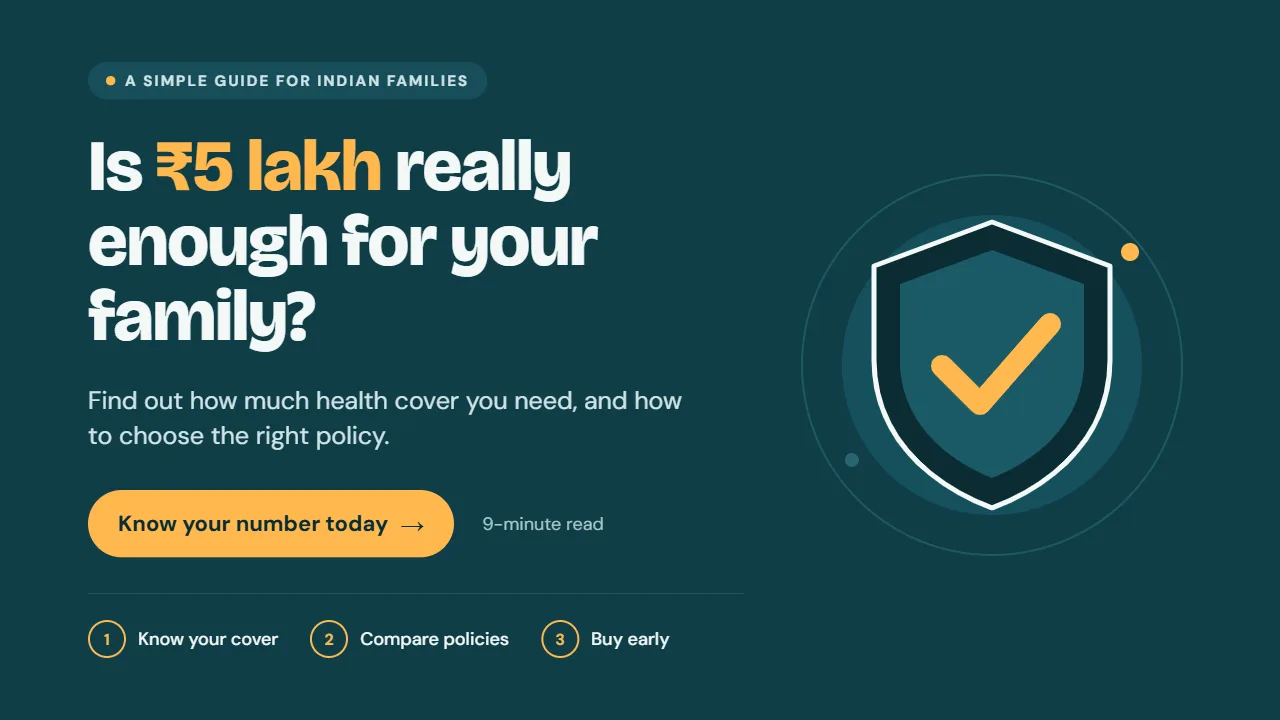
A simple guide for Indian families who want to be protected without overpaying.
Think about the last few years of your life. You've saved carefully, paid your EMIs, put money aside for your kids, and tried to plan for retirement.
Then someone in the family lands in hospital, and the bill comes to several lakhs.
At that moment, you should be thinking about their recovery. You shouldn't be wondering whether your bank balance can stretch far enough.
That's what health insurance is for. It isn't just another yearly expense. It keeps one bad week from undoing years of savings.
But buying it brings up real questions. How much cover is enough? Which company can you trust? Is the cheapest plan fine, or is it worth paying more? Let's go through them one by one.
1. Why do you need health insurance at all?
It protects your savings
Say your family has saved ₹5 lakh over many years, and one medical emergency costs ₹4 lakh. Without enough insurance, almost all of that money goes to the hospital. The money you'd set aside for a home, school fees or retirement can vanish in a few days.
Insurance can pay for eligible expenses (within the policy's terms and limits), so more of your savings stay where they belong.
Medical costs don't send a warning
You can plan rent, school fees and loan payments. You can't plan a surgery. A short stay still adds up through room charges, tests, medicines, procedures and doctors' fees. A major illness can mean expensive treatment and many follow-up visits. And sometimes more than one person needs care in the same year.
It keeps you from borrowing or asking for help
Without cover, people end up borrowing, selling investments or turning to relatives. Insurance won't remove every out-of-pocket cost, but it makes it much less likely that an illness turns into a money crisis too.
It lets you focus on treatment
With the right policy, you can spend your energy understanding the treatment and following the doctor's advice instead of worrying about the next payment.
One honest caution: insurance doesn't guarantee cashless treatment at every hospital, or payment of every rupee billed. What's covered depends on your policy, the hospital, approvals, exclusions and waiting periods.
The takeaway: You don't buy health insurance because you expect to fall sick. You buy it because you can't know when you'll need expensive care.
2. How much cover is the right amount?
A common mistake is picking a number because a friend has it, or because an agent suggested it. Your friend may be happy with ₹5 lakh, but that doesn't mean it will be enough for your family.
The right amount depends on your age, family size, city, budget and any cover you already have. There's no single magic number.
Some starting points
These are rough figures to begin comparing, not minimums or guarantees.
|
Your situation |
Cover worth looking at |
|
Young individual |
₹10-15 lakh |
|
Young couple |
₹10-20 lakh (family floater) |
|
Couple with children |
₹15-25 lakh (family floater) |
|
Middle-aged family |
₹15-25 lakh or more |
|
Senior citizens |
Assessed individually, based on eligibility, health, affordability and benefits |
If you live in a city with expensive hospitals, consider higher cover, or a base policy plus a super top-up. Parents often do better with their own separate policies rather than sharing your family floater.
Four questions to work out your number
1. What could a big hospital stay cost? Look up the approximate cost of common surgeries and ICU care at good hospitals in your city. Plan for the expensive scenarios, not just the small ones.
2. How many people share the cover? In a family floater, everyone shares one sum insured. If one person uses most of it, there's less left for the others that year.
3. What will costs look like in 5-10 years? Medical costs keep rising. A cover that feels comfortable today may feel thin in ten years, so review it every so often.
4. What can you comfortably afford? A policy only helps if you can keep paying for it. A good base policy, plus a super top-up if needed, is often a cheaper way to get more protection.
An example
Take a couple with two children living in Surat. A major hospitalisation might look like this (made-up numbers, not real quotes):
|
What you pay for |
Rough amount |
|
Room, ICU and nursing |
₹1,50,000 |
|
Surgery and specialist fees |
₹2,00,000 |
|
Medicines, tests and procedures |
₹1,00,000 |
|
Other eligible hospital costs |
₹50,000 |
|
Total |
₹5,00,000 |
A ₹5 lakh policy could be used up by this one stay. If someone else falls ill later that year, there's little left. That's why many families compare ₹15 lakh or higher cover instead of assuming ₹5 lakh is fine.
Bigger base policy, or a super top-up?
A super top-up starts paying after your eligible expenses cross a set amount (the "deductible"). For example, you could compare:
• A ₹10 lakh base policy, plus
• A ₹25 lakh super top-up with a ₹10 lakh deductible
Together, that could give up to ₹35 lakh of protection. But it isn't the same as one plain ₹35 lakh policy. Check the deductible, how claims add up across the two policies, and the exclusions before you decide.
My advice: First decide how much cover you actually need. Then compare different combinations of base policy and top-up to find the one that gets you there at a price you can keep paying.
3. How do you choose an insurance company?
A famous name doesn't mean every policy from that company suits you. And a lesser-known insurer shouldn't be ruled out without a look. Judge both the company and the specific policy.
Six things to check
1. What's covered and what isn't. Look at room-rent limits, ICU limits, limits on specific diseases, co-payments, deductibles and items the insurer won't pay for. A big sum insured can still leave you with a big bill if the conditions are strict.
2. Waiting periods. Check how long you must wait before pre-existing conditions and certain treatments are covered. If you already have a health condition, declare it honestly and ask how the insurer will treat it.
3. Hospitals and cashless treatment. Check whether the hospitals you'd actually go to are in the network. If you're in Surat, your local hospitals matter more than a big national number. Networks can change, so confirm before you buy and again before any planned treatment.
4. Claim record and service. Look at claim settlement data, complaint trends and how easy the claims process is. Don't judge on one claim settlement ratio. Ask what it measures and for what period. Past performance doesn't promise how yours will go.
5. Renewal terms. Health insurance is a long relationship. Check how premiums rise with age, and look at restoration benefits, cumulative bonuses and how you can increase cover later. Don't be swayed by a cheap first-year premium.
6. Honesty and support. A good insurer or advisor tells you the limitations and waiting periods before you buy, not after a claim. Make sure you get and read the Customer Information Sheet and the full policy wording.
IRDAI, the insurance regulator, has consumer guidance on disclosures, exclusions, waiting periods, co-payments and hospital networks. It's a good place to start.
Comparing two insurers
Here's a made-up example of two ₹15 lakh policies:
|
|
Insurer A |
Insurer B |
|
Yearly premium |
₹12,000 |
₹15,000 |
|
Room-rent limit |
Yes |
No cap (check wording) |
|
Co-payment |
20% |
None |
|
Your preferred hospitals |
Few |
Better match |
|
Waiting period for a key treatment |
Longer |
Shorter |
Insurer A is ₹3,000 cheaper, but Insurer B may protect your family far better. Of course, you'd still want to look at other benefits, exclusions and service quality before deciding.
The right company is the one whose policy fits your needs, has a decent service and claims record, and stays affordable for years.
4. How much should the premium matter?
It matters. Your insurance has to fit your budget. But the lowest premium isn't always the best deal.
You wouldn't buy a helmet just because it's the cheapest. You'd want to know how well it protects you. Same idea here.
The real cost of a policy
Compare two policies with the same sum insured:
|
|
Policy A |
Policy B |
|
Yearly premium |
₹12,000 |
₹15,000 |
|
Co-payment |
20% |
None |
Say you make an eligible claim of ₹5 lakh, and the 20% co-payment applies to the whole amount. With Policy A you'd pay ₹1 lakh yourself. With Policy B you'd pay nothing extra (assuming no other deductions). The ₹3,000 you saved on the premium would be small next to that ₹1 lakh.
That doesn't make Policy B better in every way. It just shows how a cheap premium can cost you more later. Your actual out-of-pocket cost also depends on exclusions, deductibles, room eligibility and items the insurer won't pay for.
When the premium should come first
• When two policies are truly similar: same coverage, exclusions, service and hospitals? Then pick the cheaper one.
• When money is tight: a good policy you can keep renewing beats an expensive one you'll have to drop.
• When the cheap policy has harsh conditions: paying a little more for better protection is often worth it.
• When your renewal premium jumps: find out why, and compare other options. But don't cancel your current policy before understanding what you'd lose by switching.
Finding the balance
A good decision balances three things:
• Enough protection: cover that matches real medical risks, with terms that keep avoidable costs low.
• A premium you can sustain: affordable now, and manageable as you age.
• Service you can rely on: clear terms, access to the right hospitals, and a claims process you understand.
The goal isn't the cheapest policy or the most expensive one. It's the right protection for the money you can keep spending year after year.
Final thoughts: buy before you urgently need it
Many families put it off. They feel healthy, they think the employer's policy is enough, or the premium feels like a waste.
But whether you get cover, and at what price, depends on the insurer's assessment. If a health problem shows up first, getting good cover can become harder and costlier.
If your employer gives you insurance, check its limits and conditions, and think about an independent policy as well. Don't assume that cover will follow you when you change jobs.
Five things to remember
1. Start early. Buy while good cover is easy to get and affordable.
2. Choose cover based on your family's needs, not on what someone else has.
3. Read the policy wording. The sum insured alone doesn't tell you what you'll actually get paid.
4. Compare insurers fairly. Look at coverage, hospitals, service and claims information.
5. Look beyond the premium. A lower yearly price can mean higher risk.
In the end, health insurance protects more than money. It protects the stability you've worked hard to build, so that when life gets uncertain, your family has one less thing to carry.
Disclaimer: This article is for general information and is not personal insurance advice. Policy terms, premiums, eligibility and benefits vary. Read the latest policy wording and Customer Information Sheet before you buy.
Disclaimer: The views expressed are the personal opinions of the contributing practitioner and do not constitute investment consultancy or professional insights. Mutual Fund investments are subject to market risks — read all scheme-related documents carefully before investing.
Discussion (0)
Please Sign In or Register to join the discussion.
No comments yet. Be the first to share your thoughts.